
51 Facts About Our World To Remember When You’re Building Your World
When you’re creating a world for your game or novel, it helps to have a bunch of facts about our world at your fingertips. This serves two purposes:
- You get the dimensions of things on our world as a guide whether you want things to be similar to earth or vastly different.
- You can be reminded of some unusual things to include in your world such as fjords that lead to a maelstrom or the largest freshwater lake.
Now here’s the list:
- The earth surface area is about 197 million square miles; about 70.8% is water.
- The earth’s axis tilt is about 23.5 degrees.
- The equatorial diameter of the Earth is 12,756 km (7,926 mi).
- Due to the earth’s rotation, the earth’s equator is 43km larger across than from pole to pole. It is an oblate spheroid.
- It takes 23 hours, 56 minutes and 4 seconds for the earth to spin one revolution. But why is a day 24 hours? (See next point.)
- The Sun moves compared to the background stars by about 1°. The motion from that combined with the earth’s spin adds up to 24 hours.
- The earth has 2 co-orbital satellites in addition to the moon which directly orbits earth.
- “3753 Cruithne” is one of these satellites and is 5 km across. It seems to follow the earth around the sun but has its own orbit.
- “2002 AA29″ is just 60 meters across. It has a horseshoe orbit that brings it near earth every 95 years. Scientists believe that in about 600 years it will have a quasi-satellite orbit around earth.
- The highest point above sea level on earth is Mount Everest in Nepal at 8,848 m (29,029 ft) above sea level.
- The Himalayas are the highest mountain range.
- The Himalayas are almost completely circled by three of the world’s largest rivers–the Indus to the north and west, the Brahmaputra to the north and east, and the Ganges on the southern side.
- The lowest natural point on land is the shore of the Dead Sea at 418 m (1,371 ft) below sea level.
- The Dead Sea is eight times as salty as regular seawater. (Utah’s Great Slat Lake is six times as salty as sea water.)
- The lowest natural point underwater is Challenger Deep in the Mariana Trench (between Japan and New Guinea) at 10,911 m (35,797 ft) below sea level.
- The lowest point in a lake is in Baikal Lake in Russia at 5,315 ft.
- Largest freshwater lake: Lake Superior in North America at 82,000 km2.
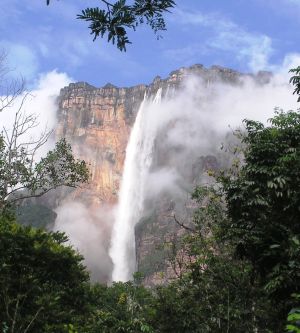
- Tallest waterfall: Angel Falls in Venezuela is 979 m (3,212 ft) and a plunge of 807 m (2,648 ft).
- The longest river is contested. Some say the Nile is longest at 6,695km (4,160mi) and other rivers are shorter. Others sources measure the Amazon as longest at 6,992 km (4,344 miles).
- The Nile river is made up of two rivers, the White Nile and the Blue Nile. The White Nile is longer and used for the overall river’s measurement.
- The Amazon’s flow and volume is so great that it pushes back the Atlantic Ocean’s saltwater for more than 160km (100mi), creating a large freshwater area.
- The Amazon’s largest tributary is the Rio Negro. The river’s waters are black from an acid in the swamps of Colombia.
- The Grand Canyon is the largest gorge on Earth, extending for 444km (277mi).
- At the Grand Canyon’s Granite Gorge, the canyon drops for 1.6km (1mi).
- The Grand Canyon’s widest point spans 29km (18mi).
- About 160 volcanoes erupt each decade, and about 550 different ones have erupted through recorded history.
- The coldest recorded temperature was -89 degrees Celsius (-129 degrees Fahrenheit) in Vostok, Antarctica.
- Only 3% of water is fresh water. Two-thirds of that is frozen in glaciers.
- 200 million years ago Earth contained only one land mass called Pangea.
- Largest structure made by living things: Australia’s Great barrier Reef at 2,010km (1,250mi) long.
- 90% of the Great Barrier Reef is underwater.
- Largest body of floating water: Ross ice Shelf in a large bay of Antactica. It is 800km (500mi) long and 750m (2,400ft) thick near the true south pole.
- The Ross Ice Shelf moves 1.6m (5ft) and 3m (10ft) each day. It is pushed by glaciers behind it, snow from above and ice from below.
- Icebergs from the Ross Ice Shelf are typically 40km (25mi) long.
- Saltstruamen is the world’s strongest whirlpool/maelstorm 30 km east of the city of Bodø, Norway. Water speeds approach 22 knots (about 40km/hour). It is formed where a narrow channel connects the outer Saltfjord with the large Skjerstadfjord.
- The largest cave is the Son Doong cave of Vietnam at 262-by-262 feet (80-by-80 meters) in most places and 2.8 miles long. It was just discovered in 2009.
- The Son Doong cave is likely even larger because a flooded section prevented explorers from traveling further.
- The Son Doong cave also has Stalagmites over 230 feet high.
- Longest Fjord in the world: Sognefjord, on the western coast of Norway extending 200km (125 mi) inland.
- Deepest Fjord in the world: also Sognefjord. Its sheer cliffs are 900m (3,000ft) in places.
- The largest island is Greenland at 2,130,800 km2 (822,706 sq mi).
- Greenland is thought to be three separate islands beneath an ice sheet. But the next largest island is New Guinea at 785,753 km2 (303,381 sq mi) so one of the three island of Greenland would likely still be the largest island.
- The largest sea is the South China Sea at 2,974,600 square km.
- There are four types of deserts: Subtropical, Cool Coastal, Cold Winter and Polar.
- The largest desert is the Sahara, a Subtropical desert at 3,320,000 square miles.
- The hottest place int he world is Dalol, Denakil Depression, Ethiopia. Its annual average temperature is 93.2°F (34°C.)
- The coldest place is Plateau Station, Antarctica, with an annual average temperature of -56.7°C.
- The driest place is Atacama Desert, Chile with an imperceptible rainfall on a yearly basis.
- The driest inhabited place is Aswan Egypt at 0.02 inches of rain per year.
- The wettest place is Mawsynram, Assam, India. It has an annual average rainfall of 11,873 mm, (467.4″.)
- The wettest inhabited place is Buenaventira, Colombia at 267 inches of rain per year.
I’ll likely do 50 more in a couple of weeks to get to over 100. If you have a few to offer, please post in the comments.
Double check #26: At 160 eruptions per decade, “recorded history” would be about 33 years…
As for another interesting maxima: the deepest cave (currently measured) is the Krubera Cave (in Georgia, the Eastern European one) at ~2200 m from highest entrance to lowest explored point.
Because the same volcanoes erupt over and over again, 550 different volcanoes have erupted in recorded history. 160 different ones in a given decade. And 50-60 in a month. But many of the same ones erupt again and again.
Ah. Got it. I read that such that “volcanos” = eruption event. Obviously that isn’t true. Thanks for the clarification.