
Hexploration Guidance from the Hexploration Decks
[Note: These rules/guidance/ideas come from our Hexploration Decks, currently out to backers to review before printing. These are most of the final 5 Reference cards from the ‘Into the Wilderness’ deck. Because they are cards of 200-225 words each, you may notice some tight phrasing. Each of the 5 decks has 40 location cards and 10 trait cards plus 5 reference/extra cards. You can still pre-order them here. –22 May 2025]
Running a Hexploration game takes a few steps, but the prep helps you flesh out the campaign setting. Keep in mind: Do the prep needed plus what is fun! Note: hex crawls don’t need a hex map! Lay a transparent grid over any map or use rough measurements. The “Hex” in hex crawl is simply a way to better support wilderness exploration and travel. Hexes make it easier, but the key is that the hex crawl process makes you think about a player-driven campaign setup. Most of these guidelines can also apply to point crawls (less about travel) and sandboxes (even more player driven).
Key Steps
- Make a map. This can be just a few hexes/small areas. Or if inspired, you can do more.
- Populate it with interesting things–the purpose of these cards! Start with just a handful and at first you only need a few bullets each.
- Inspired by #2, add factions & foes: monster lairs & territory, country/province boundaries, etc.
- Expand places closest to the PCs or any they show an interest in visiting. Develop rumors of each.
- Share a partial map (what the PCs know) with the players and feed them some rumors in their backstories, equipping, and meeting each other.
- Develop a chart for the area’s weather.
- Have rules for travel, getting lost, encounters, etc. We have some later in these instructions.
Map-Making
Many online/software tools help you make a map–hexed or not. A hex crawl can be done on a non-hex map using a hex overlay or estimating distances. This deck supports creating a campaign with any map, but our Hexploration Tiles are a natural fit: just lay several out! Our Worldographer has a free version and can make a world or region map instantly. With it, you can even start a blank map, then rough it in (hills here, forest there). Its Terrain Wizard will fill the rest.
Die Drop Process
Drop dice on hex paper. Start with water and drop a d20, d12, etc–as many as you want. If a d20 is 15, make 15 water hexes there, etc. Repeat for mountains; add hills around them. Drop more dice for extra hills. Repeat for other terrain. Did desert overlap forest? Be creative: perhaps that is “dead forest”.
Other Methods
Find other ideas online. For example, there’s a pizza box method (grease on the box is the landmass).
Reasons to Pick a Hex Map Scale
• 6-Mile Hex: At a hex’s center you can just see the next hex; people walk up to 3 miles/hour in easy terrain so 2 hours on a road=one easy terrain hex.
• 5-Mile: Similar to 6, but adjusts because roads aren’t straight and you need to see a bit into a hex.
• 3-Mile: As 6-mile but 1 easy hex/hr; view 2 hexes.
• 8 or 10: Show larger area; see only part of hex.
Hex/Area Stocking
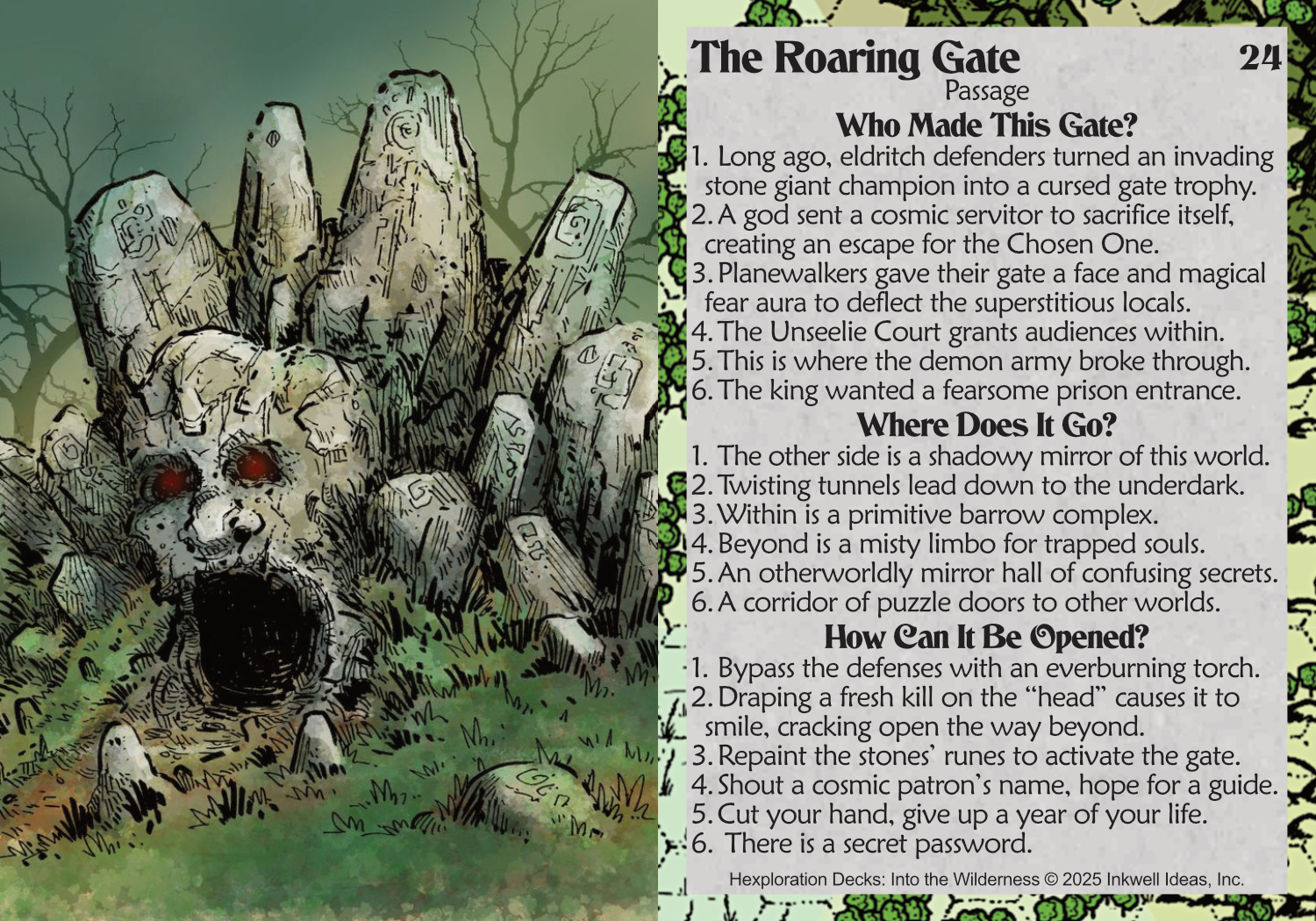
This deck has ideas for many interesting locations you can add to your campaign area–each with imaginative options you can roll or choose among. Extra trait cards allow you to vary the location even more! For example, develop a Coastal Town with that card and then apply the “Imminent Threat” to it.
Core Concept
Many GMs have a core concept for the backdrop of the campaign. This can be an idea that initiated the campaign, or it can evolve as you create. For example, you may have an initial idea of an elf/dwarf war as the backdrop. Let this influence or override the options you choose on a location card. A fort is likely to be elven or dwarven. Or discover the core concept as you place locations: perhaps a fort near a dragon’s lair is key. As you continue, consider how each new location is impacted by the core concept and locations developed so far.
Factions
Consider nearby factions as you add new locations. New locations may inspire you to change or add factions. Perhaps a faction has declined as a new one entered the scene. In a dwarven area that follows traditional dwarven tropes, what is the purpose of a logging camp? Is it a subgroup of dwarves that hate underground? Or is a new faction encroaching on the area?
Point of Interest Frequency
Many hex crawls use 5 or 6 mile hexes because some early games had one point of interest (PoI) per hex at that scale. Others had a 1-in-6 chance of a PoI per hex. Some argue real world medieval Europe had one PoI per 3 miles. Others think even one location per 5-6 miles is too much… Use the frequency that makes a fun game for you! Start with 4-5 initial locations a day or two’s travel apart and give them several details. Then pick the party’s starting location. Make more if needed to ensure that location is surrounded with a few key spots in each direction. Look at the map again and look for likely places for a several more. Develop a few notes for each–more if the PCs show interest.
Filling It All In?
You certainly can detail each hex, but it isn’t necessary and leaving half (or more) blank lets you detail as needed (when the pace seems slow) or as plot demands. (“Those cultists perform rituals over there hidden in jungle–that’s why you missed it.”)
Empty hexes can simply be skipped–the GM can make a couple fake rolls–or describe the remains of something. (“You see a few dead bandit bodies and bugbear tracks.”) The party can decide to follow the tracks or keep to the main quest.
A GM can also make a list of simple locations for these hexes like a farm, cabin, animal den, etc.
Preparation: What to Detail
Unless inspired, a few bullets per location is enough.
Developing the Location
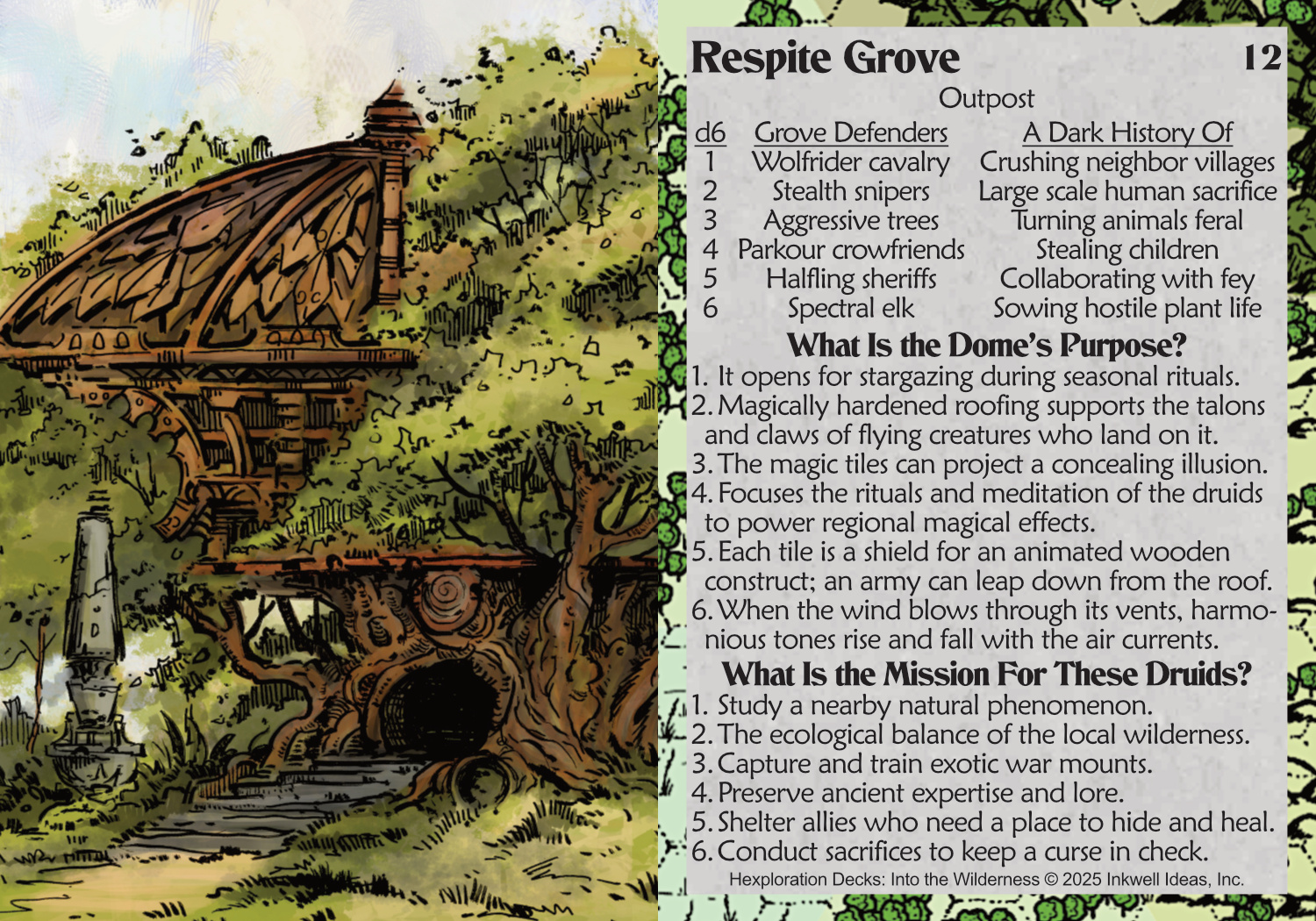
Draw (or pick based on the art) a Location card. Pick/roll for the many options on the card to make it unique. Draw or pick a trait card to customize the location further if you wish. You only need a few points for each location, and you don’t have to populate the whole map–just near the start & important places.
Obvious, Discovered, Hidden
A key idea in hex crawls is a given location has an obvious feature seen just when passing through; more info discovered with interaction, and something hidden which can be uncovered. In the case of a Fort, the Fort’s location and faction is obvious. The size of its forces, commander’s attitude, etc., is discovered. But his secret mission is hidden, for example.
Rumors
Another key concept is to develop a couple rumors about each location to have ready later. You may choose to feed some of these to your players early, or have them ready to go during the campaign.
Getting Started
A key part of any player-driven campaign is giving the PCs some of those rumors and letting them decide which to pursue. The tavern, shopkeepers, fellow prisoners in jail, a story in a book, captured foe, notes on a map, etc., can all be rumor sources.
Travel
Travel rates for varying terrain are below. Double them if mounted. “Forced”=traveling faster/longer.
Travel Rates Per Day By Terrain in Miles
| Conditions | Easy | Moderate | Hard |
|---|---|---|---|
| No Trail or Road | 12 | 9 | 6 |
| Trail/Road or Forced | 18 | 12 | 9 |
| Trail/Road and Forced | 24 | 18 | 12 |
Easy: Farmland, Grassland; Moderate: Hills, Forest, Desert, Badlands; Hard: Mountains, Jungle, Swamp.
On a hex map, divide the number above by the hex scale. So 18 miles/day on a 6-mile/hex map is 3 hexes of travel.
Note: If traveling quickly (Forced), they suffer penalties to spot foes or details. The PCs can take their time to explore/map and gain a perception bonus by traveling 2/3 speed.
Getting Lost
If the party isn’t on a road or in sight of a landmark, there is a 2 in 6 chance of getting lost. Reduce this by 1 if a PC has a wilderness background; reduce by 1 again if they go slow. If lost, take the map until they recognize a location.
Foraging
Foraging extends rations. In dry areas, water is also key. Roll a d6: 1-3: none; 4: 1 meal; 5: 1d6 meals; 6: 2d6 meals.
Add 1 per each: useful skill, plentiful area; familiar area; dedicated forager PC. Subtract 1 each: Heavy armor, bad weather, desert/winter, not alone.
Travel Roles & Weather
Roles
As the party travels the area, each member may take on a role to improve the group’s travel.
- Forage – Someone dedicated to looking for good spots to forage will improve foraging chances.
- Forecast – A character concerned about the weather can reduce travel delays by knowing when to push on and when the party will need to stop anyway.
- Map – A character who maps will reduce the chance of becoming lost.
- Scout – Reduces the chance of being surprised.
- Quartermaster – Optionally, you can roll each time the party breaks camp to lose/forget an item. A quartermaster prevents/reduces this loss.
Weather
Weather is a function of an area’s climate and season. Weather tables can be another whole deck of cards so quick and simple approach is to think of the real world equivalent area and its climate for your campaign’s current season. Roll a d6 for temperature and a d6 for chance of rain. The biome & season impacts these. Ex: A savanna in a dry season may only have rain on a 6, but in the wet season maybe 4-6. A temperature of ‘3’ might be slightly below average. Add unusual events if you roll double “1”s: monsoon, tornado, blizzard, etc.
Travel Encounters
Develop a few lists of encounters based on terrain and what is nearby. For example, consider a desert region with snakeman villages and a hobgoblin fort. List a few creatures/groups the party may encounter there. To make an encounter more dynamic, give each a likely activity & complication. Choose or roll, and interpret as needed. Ask yourself ‘why?’ those in the encounter are doing what they are doing, and why it is complicated, to add interest! A rabid vulture is spying? A wizard is possessing it! … Why?
Example Encounters By Terrain & Area
| d6 | Creatures | Activity | Complication |
|---|---|---|---|
| 1 | Sm. snakeman group | Raiding | Carrying a lot |
| 2 | Lg. snakeman group | Wargames | Rabid |
| 3 | Giant vulture | Scavenging | Wounded |
| 4 | Ankheg | Childcare | Feeding |
| 5 | Hobgoblins | Spying | Out of water |
| 6 | Blue dragon | Sunning self | Bored |
You might wish to create alternate versions for different parts of your map–if the options would vary, and if the party may go there. This example is closer to the snakeman villages, but if near the hobgoblins drop row 2 and add another hobgoblin idea. Remember, you don’t need to over-prep by making many lists!
The PCs may dictate an encounter based on their actions, but default to a 2-in-6 chance of an encounter. Adjust by 1 or 2 depending on the party’s stealth and the density of the local population.
Wilderness Travel/Exploration Process
If you don’t have travel rules you like, try these:
Sequence
- GM determines the day’s weather (see above).
- Break camp. If no PC is a quartermaster (above), there is a 1-in-6 chance of losing a random item. (It costs 1 hex of travel to go back.)
- The party picks the next hex to travel to, using movement rates above. If the party has no forecaster, rates are reduced by 1/3 in rain or extreme heat or cold.
- GM determines if PCs get lost. Again, see above. If the party has a mapper, the chances lower by 1.
- Party moves into the next hex. GM describes the area and rolls a d6 for a random encounter. Roads turn a 1 into bandits (usually 1-2 on a new d6 roll) or fellow travelers (3-4 on that 2nd d6 roll) or normal encounter based on terrain (5-6):
Clear, Grassland, same hex as City/Town: 1 in 6.
Hills, Badlands, Desert, Forest: 2 in 6.
Mountains, Jungle, Swamp: 3 in 6.
Note: The PCs are less likely to be surprised by foes if a PC is a scout. - GM describes any unusual feature or point-of-interest in the hex, asking the party for their plans.
- Repeat from step 3 if the party has move left.
- Make camp. Mark off rations, but the party may forage for food (above). Hunt a full day (also above).