
How To Set Up A Starting Campaign Area / Hex Crawl
[For a short version of this article, just read the headlines & bold text.]
Setting up a hex crawl doesn’t have to be a lot of work or some arcane process if you focus on what you need for your next session & where you’re inspired. Whether you want to use our Hexploration Tiles or our Hexographer/Worldographer programs or something else, making a starting campaign area is easy. And filling out a few initial locations doesn’t have to be more than a few bullets in most cases.
You can even do this exercise with your players as part of your session zero–when you’re making up characters. As you discuss the type of campaign you wish to create set up the campaign map area, several locations, and a few bullets for each. Doing so gives your players some knowledge and buy-in to your campaign setting. Of course, they shouldn’t know everything so you can decide some points are false rumors or even set the campaign several years later when things have changed.
Step 1: Create The Initial Area Map
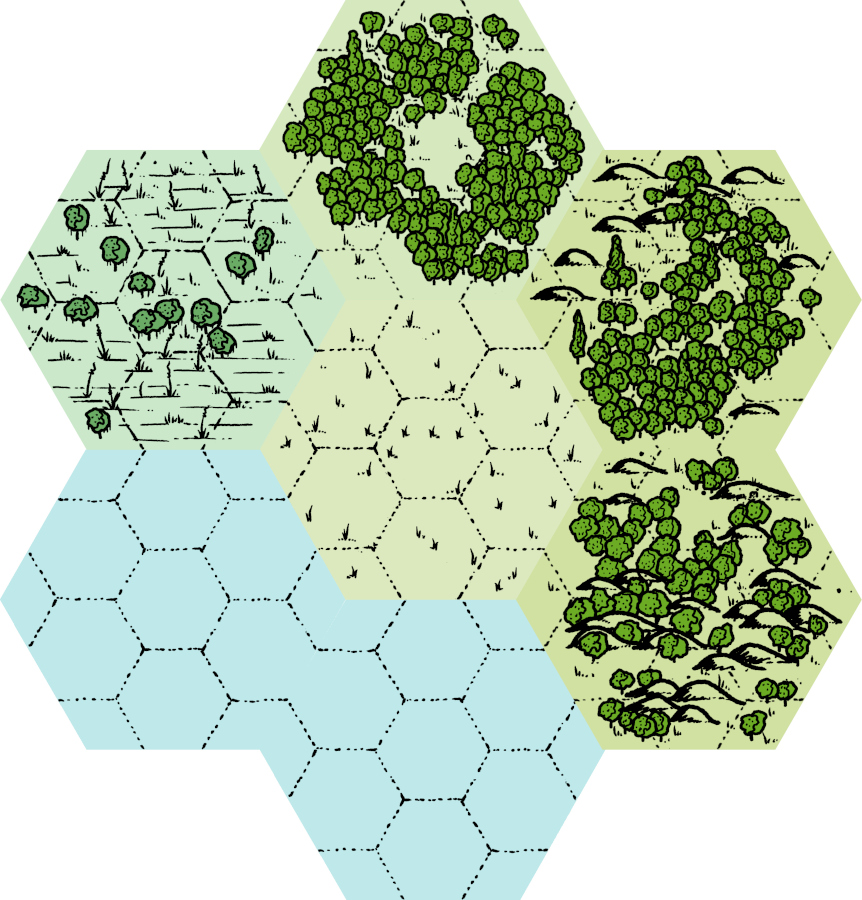
Layout the map for a couple days’ travel in each direction. Many game systems will dictate how far the party may travel in a day–but that will depend on the terrain and a few other factors (are there roads, are the PCs mounted, etc.). For example, the 2024 version of D&D says normal travel is 24 miles per day.
There are many arguments over map scale, but for this we’ll do a 6-miles-per-hex map. Some people prefer 5, some 8, others 10, and even 24 or 30 are common. If we did 24 or 30 it might get too busy looking (see below) and 6 miles allows the players to see the edge of each adjacent hex when they are roughly in the center of one in a flat area.
In the center we start with a ‘farmland’ area to make our starting location at least seem safe. Settlements will require some source of water (a river or coast–we’ll have both–although an oasis or underground source is also possible) so let’s make sure we make a couple of our tiles ‘sea’. Then we do want a variety of terrain, so we add a swamp to one side, forest on another and we do want to have mountains, but first we should have hills so we’ll pick a couple of forested hills hexes.
Step 2: Add (More) Water
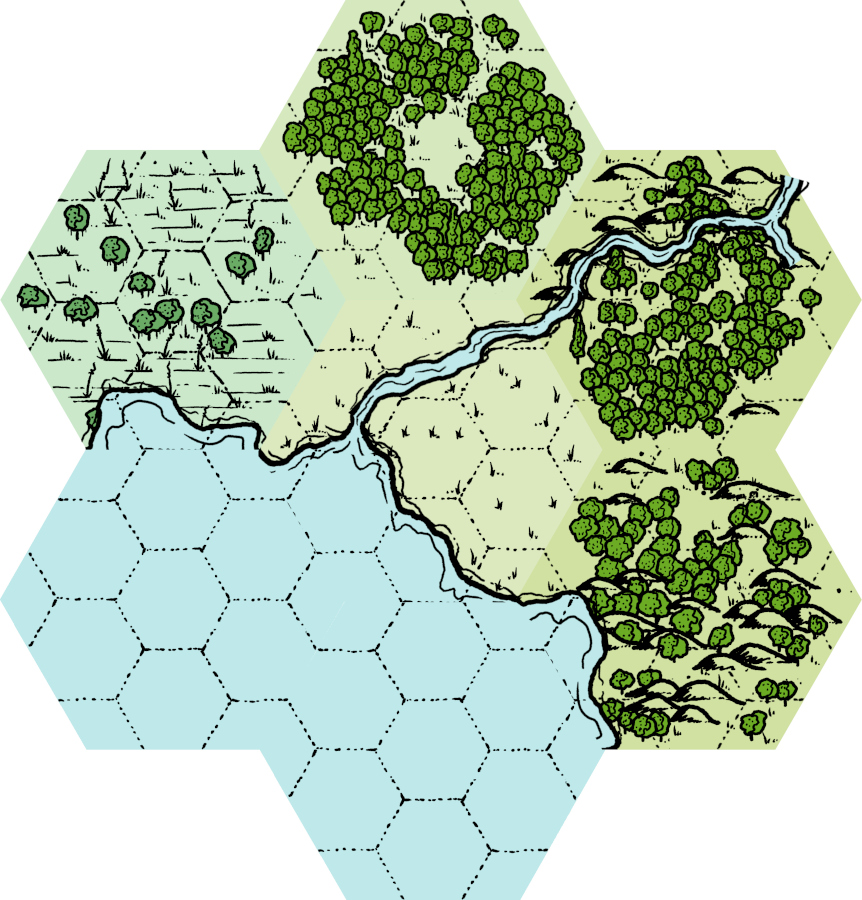
First we add a coastline to make it look prettier. Then we’ll add the river mouth. We plan to put the starting town along it and the coast, so let’s have it connect to the coast almost in the middle of the map. Next we add a couple of more river sections and a fork.
That almost gets us to the edge of the map for both rivers connecting at the fork so we’ll expand those further if & when we extend the map.
Step 3: Add the Initial Points of Interest
As we wrote above we want a starting town in the center of the map, so we put that down first. Then we want to add a few interesting things about a day’s travel from the town.
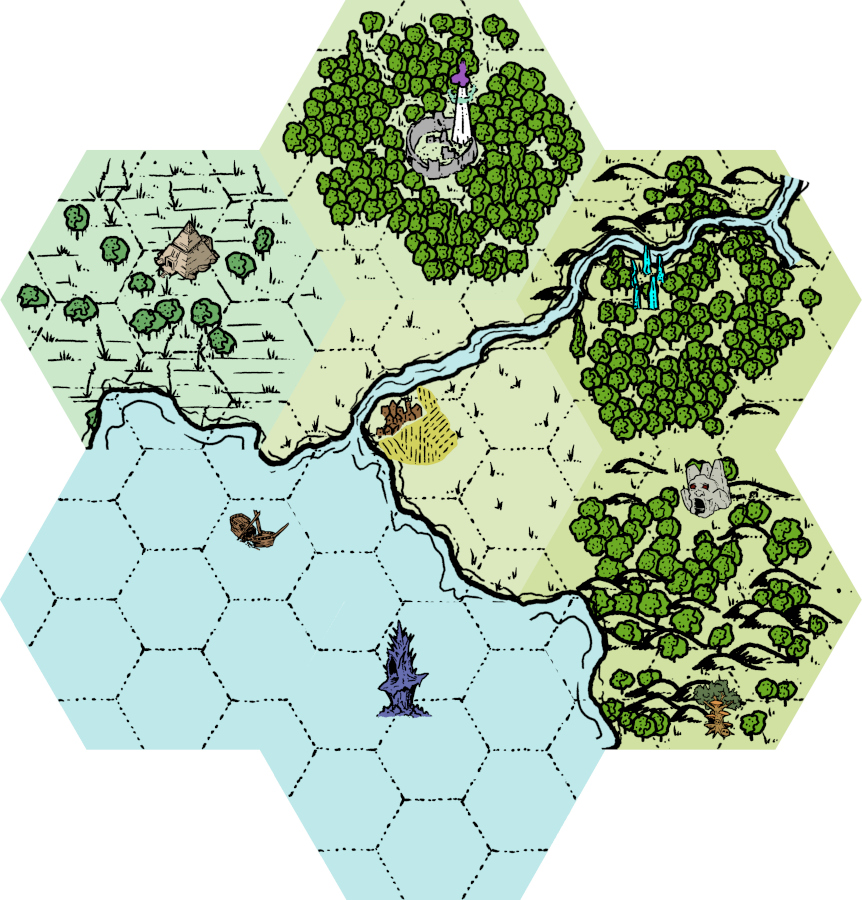
Let’s discuss the water area first. We want a reason why the town isn’t a city–it is on the coast at a river’s mouth, so it should probably be a city unless… there is some sort of evil tower off the coast preventing it from becoming a trade center. So that idea spurs placing that icon. Oh, and we should have some evidence of difficult sea travel, so let’s add a shipwreck too.
Next, swamps often contain some sort of dark magic source. Let’s put a pyramid there. Continuing clockwise, the clearing in that top forest area seems perfect for a magic tower or city, so we add that. Next, let’s stick some Stonehenge like pillars on the edge of the forest. Is it a cult or druids or something else? So far, we haven’t done a traditional dungeon or cave nearby, so we add an icon for that. And finally to round things out we add a strange tree in the forested hills near the bottom right corner.
Step 4: Detail Our Starting Location
We know our starting location will be the coastal town. So we can brainstorm some basic details about it. And for more inspiration, we can look at Inkwell Ideas’s Hexploration Decks. You can fan through these to find one you like–maybe looking for the city/town/village cards in particular. We spot one that seems perfect: in the Settled Lands deck is a “Coastal Town” card:
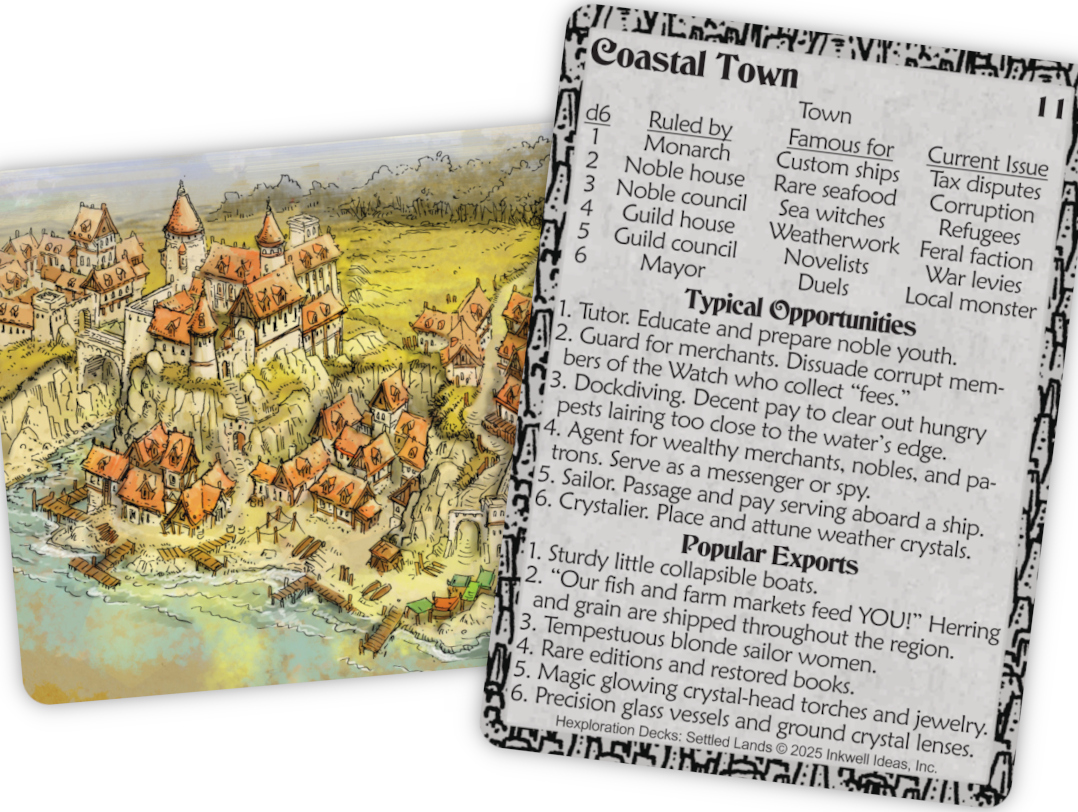
One can roll on these charts randomly or pick what interests you. In this case, we’re going to focus a bit on things that could be related to the tower in the sea. So in Typical Opportunities, Dockdiving will be a job the PCs can pick up–and learn rumors about the tower in the sea. And under Popular Exports maybe this town is famous for ground crystal lenses because folks need to see the current activity in the tower. But they could also get a job guarding caravans to the east because something is happening out by the cave to the east.
(There are a bunch of other great resources for picking or randomly rolling details about locations. A few more are the Tome of Adventure Design, Ultimate Toolbox, Gamemaster’s Apprentice Decks, and the Dread Thinganomicon.)
Really, many of the options can be fit into the setting and give you an opportunity to pass rumors on to the characters: Tutoring may be in demand because the wealthy want their kids to be invited to that magic city (if that’s what it is). Or serving aboard ship is bound to tell the characters more about the tower or the shipwreck. And we haven’t said anything about the pyramid to the west or the stone circle to the northeast–perhaps the rare books mentioned in “Popular Exports” might have been found in the pyramid then fenced in the town and sold to whoever is worshiping in the stone circle.
For some of the other points on the card, war levies could be high because the leaders are raising a force to “take care of” either the sea tower or the bandits to the east. For the ruler we could pick randomly, but it seems like a guild or anyone elected would have dealt with the sea tower earlier, so we choose Monarch.
Oh, and one of the last cards of the Settled Lands deck has a few lists of syllables and words we can combine to name our town. We’ll pick Portmill because it is a port, and there are many farms (according to the icon we chose) so we’ll say a mill was one of the first buildings established.
Next, we could go on and perhaps sketch a town map, list the key buildings (an inn/tavern or two, the mill, key artisans with items for sale, towers and walls, etc.) and a few bullets about each. Likewise we should list several key people in town and a couple of points about each of them. You don’t have to do too much–focus on who the PCs are likely to meet and where they are likely to go.
Step 5: Make a Few Notes for Each Other Point of Interest
We don’t know yet where the party plans to go, so we don’t want to flesh everything out, but we do need to give them enough to tell us where they want to go.
We’ll start with that sea tower. Shuffling through the Hexplorations Decks: High Seas, we can find the card that inspired the map icon–#30:
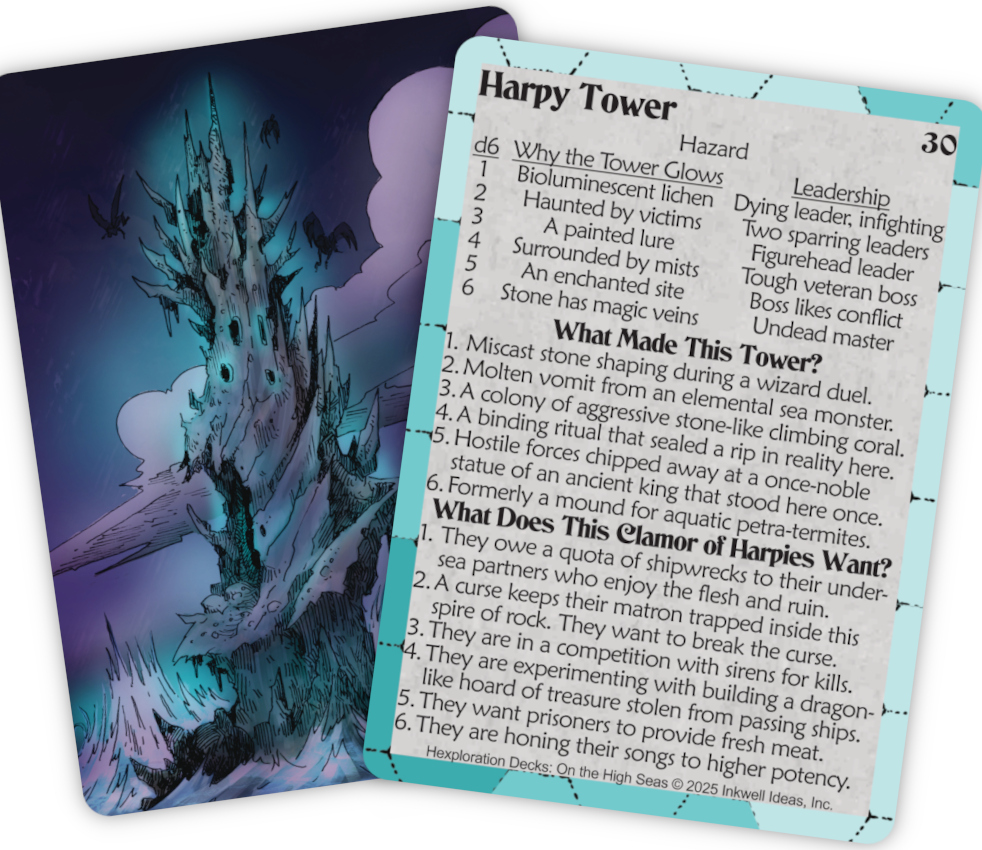
Even though this card focuses on harpies, you could apply most of the ideas to other creatures such as a sea hag coven or a tribe of sahuagin.
We will stick to harpies. For “Why the Tower Glows” the idea that it is haunted by the victims is intriguing–somehow in a failed attack against the tower in the past, the town was able to channel some magic to cause the victims to make the tower glow as a warning. Under “Leadership”, we find a good excuse why the low-level party might stand a chance against a group of harpies: the leader is dying and the harpies are fighting amongst themselves.
As for “What Made This Tower?” at first nothing seems to strike the right chord… but then glancing at “What Does This Clamor of Harpies Want?” generates an idea: they owe a quota of shipwrecks to undersea partners seems like fun, and once we consider that maybe the tower was molten vomit from an elemental sea monster. That creature and its other followers are owed flesh for occupying the tower.
For these points of interest outside the starting location, we don’t need to develop them too fully, but we do need to note a few rumors that the party may learn in town. From our example:
- The harpies are fighting amongst themselves.
- Their leader is dying/dead.
- The shipwreck was caused by them, and they try to cause more.
- An elemental sea monster formed the tower. Has it been sighted recently?
- Other sea creatures/monsters are attracted to this area because of the harpies’ activities.
Note how we can start showing how one point of interest impacts another: the harpies caused the shipwreck.
Here is another card that we could use to develop the cavern entrance to the east:
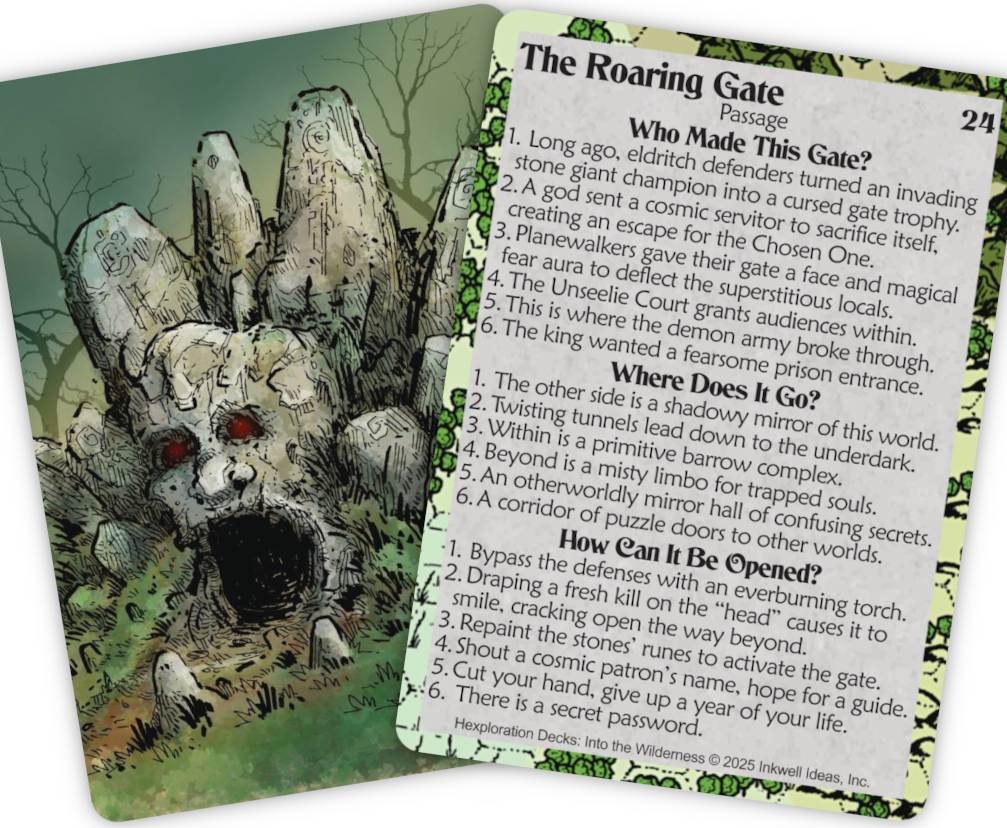
Use the ideas on this card along with our notes so far to make some bullet points and rumors about the caves to the east. For example, if it goes to the Underdark, we have some ideas of who our bandits may be and how they operate.
Step 6: Get Started!
At the end of your initial session with the players where you’re creating characters and introducing them to each other, give the characters a rumor or two (as they shop, work, hang out at the inn, etc.) about each of the locations and see where they want to go. They can even get started on their way to the location in the initial session–you don’t need to flesh out the sea tower to have sea monsters attack their boat on the way or for bandits to attack the caravan if they are guarding heading to the east. You can even have an event occur if your PCs aren’t instigating anything–sea creatures attack or an explosion is heard from the magic tower to the north!
Step 7: Expand Your Map, Adjust Locations & Repeat
As the players take on one location (say the caves to the east) you’ll want to develop a few new points of interest near that location.
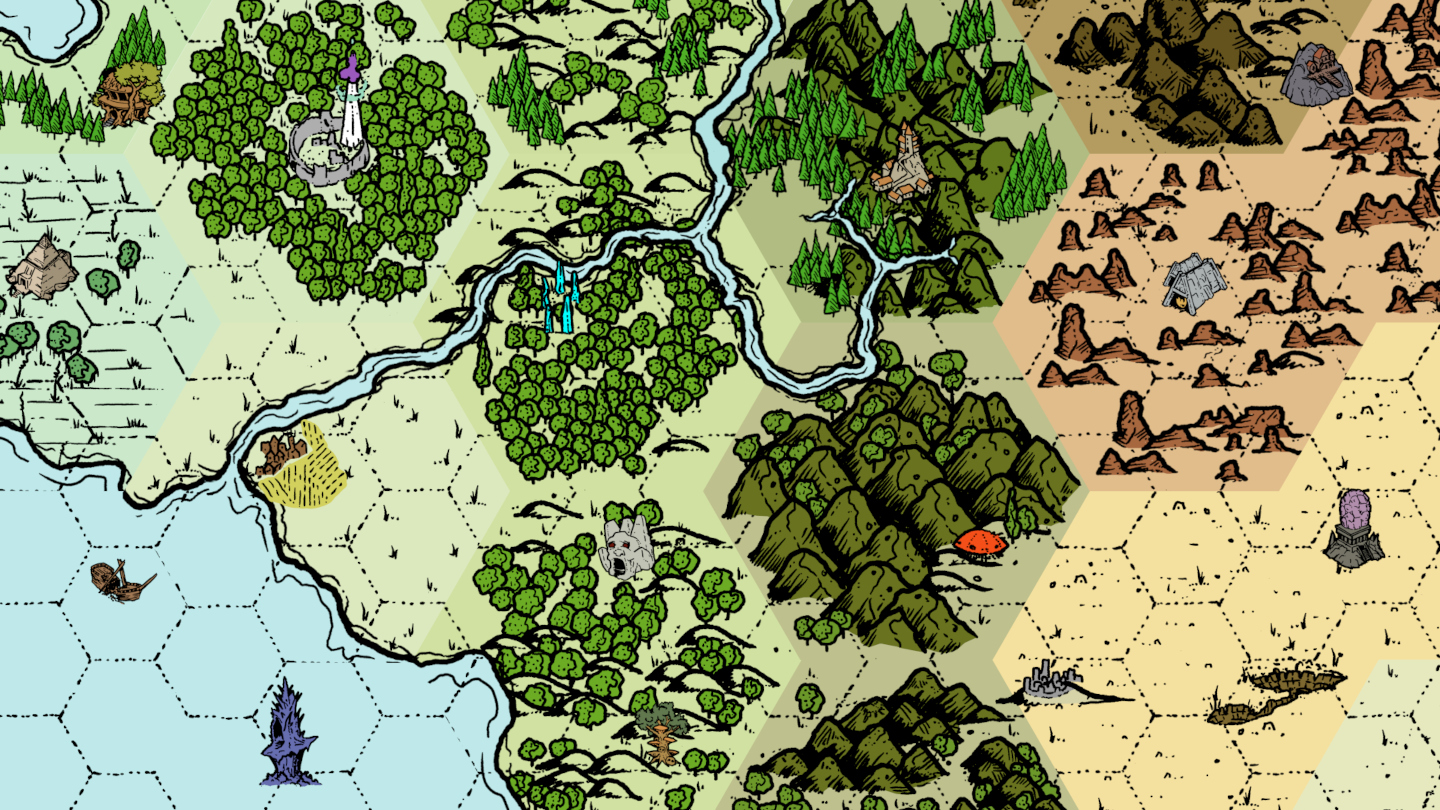
Even before they finish off the forces in a location it helps to know what else is nearby so you can consider if the forces in that tower or cave have allies or foes nearby. And these notes should have some rumors the PCs may learn.
Further, the areas the PCs didn’t explore will have ‘leveled-up’ too. If the PCs take on the bandits in the caves to the east, then the harpies in the tower have settled their leadership dispute and will be harder to assault.