
When Characters Die
by Joe Wetzel (joewetzel at gmail dot com)
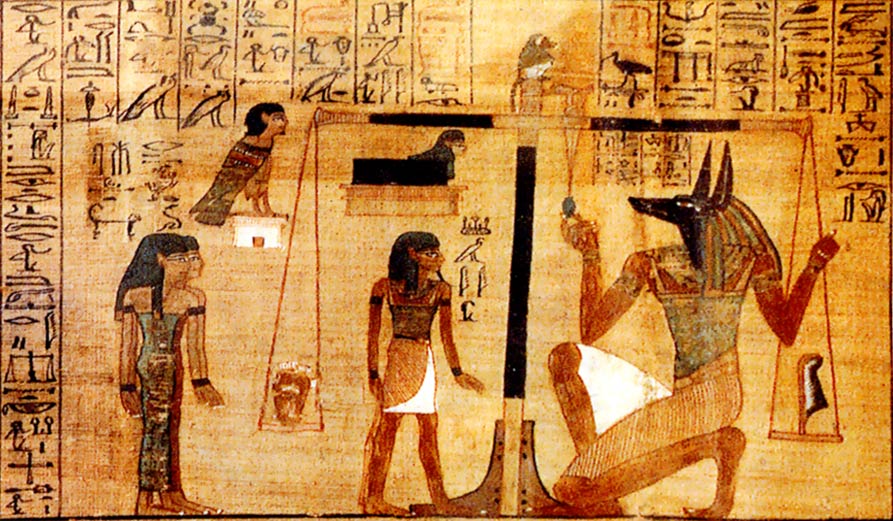
A portion of the Papyrrus of Ani from the Egyptian Book of the Dead.
When characters die, the game master and players have many possible options for what to do next. Often, what the party will want to do will depend on what the deceased character’s player wants to do. But that isn’t the best way to decide.
Some players get attached to their characters. These players enjoy seeing their characters grow and attain power and have interesting adventures. Other players can easily move on from a character. Sometimes a player (even the type who get attached) may be anxious to move on to another character because his current character concept just isn’t working for the player or the player wants to try an intriguing new character idea.
Despite these factors, in a more ideal campaign where out-of-game circumstances are largely kept out of the game what the characters do should largely be determined by each character’s relationship to the deceased character.
If the deceased character was aloof and didn’t form many bonds with the others, the party likely shouldn’t try too hard to bring him back. There may be some character-based exceptions to this which are good to role-play, but a party member shouldn’t advocate resurrecting a disliked character without a good reason.
It is important to reward good role-playing, whether each remaining party member advocates what the deceased character’s player wants or not. If necessary the game master should encourage the players to role-play their characters by pointing out what their character’s point of view would be. The game master can serve as a “devil’s advocate” in some ways.
However, if the group decides to do what the deceased character’s player wants even if what the game master believes the character would do, it is best to play it out. The game master may make it a bit more difficult to bring the character back to life (perhaps the healing needed isn’t available from the first resource they contact) to maybe give the players second thoughts on the idea, but in the end he should work with the players.
Depending on the level of magic/technology in the campaign the character can be raised from the dead through any number of spells/prayers or medicine. But even if the technology or magic for this is available, the cost may be high. In a magical setting, these are the standard spells for bringing a character back to life:
- Reincarnate (Druid 4) – This will only work one week from the time of death and if some small portion of the body from the time of death is available. An entirely new (and randomly chosen) young adult form is created for the soul to inhabit.
- Raise Dead (Cleric 5) – This will only work if the subject is dead for less than one day per caster level and one level or hit die is lost. (1st level/one hit die creatures lose 2 points of constitution instead.) The description of resurrection implies the subject’s body must be reasonably complete.
- Resurrection (Cleric 7) – Will work on subjects dead for up to 10 years as long as some small portion of the body from the time of death exists unless the subject died of old age. The subject loses one level/one hit die or 2 points of constitution if first level/one hit die.
- True Resurrection (Cleric 9) – As resurrection, but no remains are needed.
The party will have to take on the burden of paying for the character to be brought back to life. In a higher level campaign, the group may have the money to pay for the character to be brought back to life. If not there are other ways to pay. Perhaps they can take out a loan. More likely in these special circumstances (especially in a fantasy setting) they will have to obligate themselves to a major quest on behalf of someone who can bring the character back to life or someone who can pay for it.
If the characters have already completed a major task for someone of note that person may feel obligated to help them as a form of payment for that previous task. Or perhaps that person has become a close friend and genuinely want to help.
The text above uses content published under the Open Game License.
Leave a Reply
You must be logged in to post a comment.