
Random Dungeon Generators Reviewed
Random dungeon generators go way back to the early days of computer games. Text-based dungeon crawls like Hack and Moria randomly created their dungeon levels using ASCII characters, but even they have since been given graphics front-ends.
A dungeon generator can save you some time when you’re getting ready for your next game session. Two of the generators below can save you even more time by listing the contents and some aspects of each room. However, you may need to adjust these descriptions or throw them out completely to fit your needs. One also lists the dungeon’s general description (type of rock, climb difficulty, lighting, etc.)
All of the generators below scored very well in at least one way. It is not my intent to put down anyone’s work–I know from my own projects how much inspiration, effort and knowledge it takes to do anything like these. But each also has room for improvement so hopefully my critiques will be taken constructively if the people working on these see them.
“The Demonweb” Random Dungeon Generator
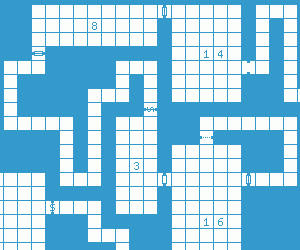
The first search result I had was for “The Demonweb” Random Dungeon Generator. (This also came up as a separate result with a different name.) The first page lets the user choose several options such as dungeon name, level, motif (undead, vermin, arcane, etc.), size, room size, room placement (sparse, scattered, or packed). The user can click a “Random” button to set each of these randomly. Or the user can set each and click “Construct” to build the dungeon. The result is a much larger and un-cropped version of the picture to the right.
Importantly, the developer of this random dungeon generator now created images for all but the “HTML” dungeon motif. Earlier versions had issues printing the maps, but this fix addresses those issues.
Below the dungeon map is short general description of the dungeon including the type of walls, temperature and illumination.
After that is a short description of each numbered location. Each of the room’s entrances described: “Locked Stone Door (Open Lock DC 25, break DC 28; hard 8, 60 hp)” for example. Then the room’s contents are listed such as “Fireplace, Sconce, Winch and pulley.” Finally, a trap or list of monsters (including their OGL 3.5-ish stats) is noted. Of course, any of this can be modified or completely thrown out if it doesn’t work for the game master.
Scores: Customizability: B; Aesthetics: B+; Variety: C; Completeness: B; Printing: B;Text Descriptions: B
(Customizability refers to how many options are available to the user. Aesthetics is how pretty are the maps the generator creates. Variety is the number of styles of rooms and corridors and other things on the map. Completeness is how well does the generator aviod too many dead ends or other things that do not make sense. Printing notes how well the dungeon (particularly the map) looks when printed. Text Descriptions refers to the detail of the text descriptions created by the generator if the generator provides them.)
Myth Weavers’ Random Dungeon Generator
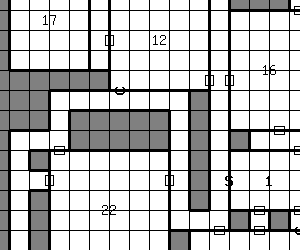
The next random dungeon generator search result is at Myth Weavers. As in the previous dungeon generator, the user can set the size of the dungeon, the sparseness, and level. Additional options include percentage settings for secret and concealed doors and settings for the room sizes. However, the Myth Weavers generator doesn’t include options for a dungeon theme/motif as The Demonweb’s generator allows.
Taking the default settings except for requesting “Many” rooms and allowing for rooms that are between two and seven squares high and wide instead of two to five squares creates a dungeon like the one to the left.
The Myth Weavers random dungeon generator also provides bullet-point style text details about the dungeon’s rooms. However, because a user can’t set a theme to the dungeon it is hard to get a random dungeon with a particular concept such as a mad wizard’s labyrinth or an undead crypt.
Printed maps created with this generator look just like the on-screen maps. You may need to select the map’s specific web page frame to print it. For very large dungeons, you may need to scale down the size you use to print the page or else the map will extend off the page. You can easily save the map image to your computer so you may edit it with an image editor or print a larger version. Although enlarging images usually loses some detail, since the Myth Weavers’ dungeon maps are very simple this is not an issue.
Scores: Customizability: B+; Aesthetics: C; Variety: C+; Completeness: B; Printing:C+; Text Descriptions: C
Gozzys’ Random Dungeon Generator
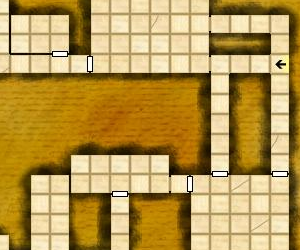
The third random dungeon generator search result is from a site called Gozzys. Like the others, it gives the user several options then the user clicks a button and the next page is the random map result.
The Gozzys site actually gives the options for two different random dungeon generators on the same page, divided in two sections.
The first section is titled “Wandering Room Type” and it includes options for map size, density maximum room width, maximum room height, background, tile set, and randomness. This represents fewer options than the other generators above offer. The background and tileset offer nice color options, however.
The second section is titled “Random Room Type.” It offers options for just map size, density, background and room set. The maps it generates have a similar look, but as the title suggests the rooms can vary greatly in shape.
It would be very interesting to see these two combined, but that may make for a rather complex algorithm to write. In any case, neither of Gozzy’s random dungeon generators provide text descriptions of the rooms or the dungeon in general.
Printed maps created with these generators look just like the on-screen maps. Like the Myth Weavers generator, you can easily save the map image to your computer so you may edit it with an image editor or print a larger version. In this case enlarging the map may look a little bit worse if you chose the more interesting tile and background colors because some detail will be lost. But the maps are still fairly simple so this is a very minor issue.
Scores: Customizability: C-; Aesthetics: B; Variety: C-; Completeness: B; Printing: B-; Text Descriptions: n/a
Hack/’s Random Dungeon Generator
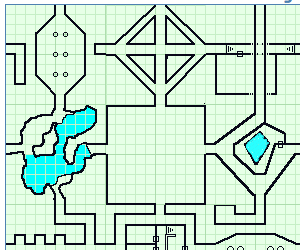
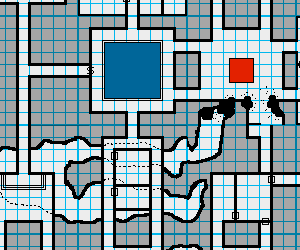
The next random dungeon generator is offered by hack/. It generates dungeon maps in a graph paper style. See the example to the left.
The inclusion of caverns and multiple elevations on the same level (see the example’s vertical corridor crossing over a horizontal corridor and room) make this generator worth a closer look. The generator relies on the dungeon being cut up into a number of 10×10 square tiles and each tile has a join corridor at the same spot along each of the four walls. This constrains the dungeon’s design. One improvement would be to allow for some tiles to have fewer of these join points and for the generator to know that some tiles can’t fit because a tile’s edge may not have a corridor to join.
A bunch of new dungeon tiles have recently been added to this random dungeon generator.
Unfortunately, the hack/ dungeon generator doesn’t allow the user to choose any options. You simply refresh the web page until you get a design you like. However, if you want a dungeon that is mostly caverns, is very labyrinthine, has very densely packed rooms, etc., you probably won’t ever get a design you like.
Printed maps created with this generator look just like the on-screen maps. However, because the maps are a set of smaller images, you can’t just save the map image to your computer. You would need to get a screen shot and import that to your image editor if you want to edit or enlarge the image. Once you do that, because the maps are fairly simple enlarging the image will only lose a small amount of detail.
Scores: Customizability: I; Aesthetics: B-; Variety: B+; Completeness: B+; Printing: B-; Text Descriptions: n/a
MapMage’s Random Dungeon Generator

Next up is MapMage. It is a paid product, running about $25, that you download and install. It seems to run only on Windows, but it has been “updated” for Windows Vista. You can choose the room size, corridor types, dungeon size (in pixels), iterations (it seems the more iterations the “better” your dungeon will be–fewer dead-ends other things that make no sense), and some other options for a river, chasm, etc.
The generated map includes information about the contents of each room, but it is system neutral because it does not offer any game statistics. This information is shown when you hover over a room.
The website offers a screenshot and a portion of one of those maps is to the right. The MapMage site also offers several other random generators that may not have as many good and free alternatives for cities, caverns, whole worlds, buildings and more.
This review can’t include how well these maps print because a copy of the product is required.
Scores: Customizability: B; Aesthetics: C-; Variety: C+; Completeness: B; Text Descriptions: B- (Note: Windows only)
Skeleton Key Games’ Random Dungeon Generator
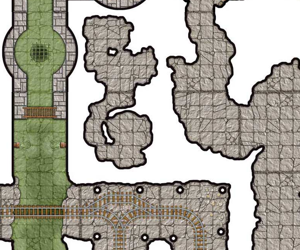
[I was under the impression that the Skeleton Key Games random dungeon generator was official or permissible. But it was removed with a note that it was “taken down due to a request by the rightsholders of Skeleton Key Games tiles.” But I’m keeping this review in place because it may help others get ideas for creating or improving another random dungeon generator.]
The final random Dungeon Generator in my search results (that worked, was not ASCII art and was within the first few pages of results) was the Skeleton Key Games random dungeon generator.
The tiles used for the map creation look beautiful, and they can be enlarged up to 300×300 pixels each. Larger versions are available as pdfs for purchase.
Customization is an issue however. The generator lets you select between a number of different tilesets, but it does not allow you to set how frequent you want the rooms to be or how large or most of the other options the other generators allow. In addition to the tile set and tile size, you may only select the dungeon’s number of tiles wide and high.
The dungeons this generator creates also often don’t make sense. It has many more dead ends (actually, the dead ends here are worse–they sometimes end with an open wall) and rooms that are not connected. The Skeleton Key games generator also does not provide text descriptions of the dungeon or its rooms. However, the tiles are so detailed that they somewhat make up for that.
If you want to print a dungeon created by this generator, you’ll need to adjust the number of tiles wide and high to fit a sheet of paper, or else adjust the sizes of the tiles or adjust the printing options. Alternatively, you should make sure your web browser’s print function includes the ability to span multiple pages in width and you need to be comfortable pasting them together. If you want to enlarge the maps, the built in option to change the tilesize works well. Unfortunately if you want to get a copy of the dungeon (especially if you set a large tile size) you may need to do several screenshots or save each tile image individually, then paste them together in an image editor. The largest tile size setting (300×300) isn’t designed to be printed such that each square in a tile is one inch for minatures use, but it will look ok. If you truly want to do that, you should consider purchasing the pdf versions.
Scores: Customizability: D; Aesthetics: A+; Variety: A; Completeness: D; Printing: C (B+ because good detail is possible, D because it is a difficult process); Text Descriptions: n/a
Wizards of the Coasts’ Mapper Random Dungeon Generator

Amazingly, the random dungeon generator from Wizards of the Coast didn’t turn up in my initial web search. Based on suggestions from readers, it is now added to this set of reviews.
Despite being tagged “beta” (although Google has long betas for very usable software, and everything on the internet is evolving if it isn’t falling into disuse) it offers many features. Dungeon size, room size, corridor size, secret doors and porticullises are some of the major map options. Additionally, a user can request room descriptions. For this feature the user can set the dungeon “level,” theme (although there are only three options for this–The Demonweb’s dungeon generator had many), simple adventure hooks, and one can turn on or off several things like wandering monsters and intro text. The user can also set which Dungeons and Dragons v3.5 books to use as resources for stocking the dungeon.
As one would expect for an official D&D resource, this is one of the better dungeon generators, although others are better in at least some ways. It is one of the few that offers descriptions complete with stocked monsters, but as mentioned above it has fewer themes to choose between. The maps are nice looking, although a few other dungeon generators produce maps that are just as nice and the tiles used by the Skeleton Key games dungeon generator look even nicer. Also lacking are any cavern options and like most of the other dungeon generators the rooms are basic rectangles and the corridors are pretty simple and don’t bend much or go in odd directions from rooms.
Printing is comparable to the Myth Weavers dungeon generator and this generator has the same issues.
Scores: Customizability: B; Aesthetics: C+; Variety: C+; Completeness: B+; Printing: C+; Text Descriptions: B+
Dyson’s Random Morph Map
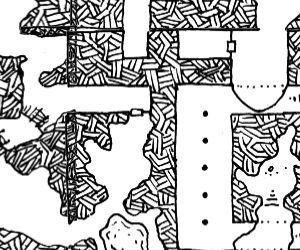
Dyson’s Random Morph Map currently has 95 tiles (and is actively growing every few days) but the variety of tiles seems even larger for some reason. Aside from that, the generator is hard to review in that it is so similar to Hack/’s.
Maybe I’m missing something, but I don’t see a difference in the functionality. (Although I’m fairly certain it is different code.) To be sure the artistic style of the tiles is much different (more sketch-like) but that’s just an aesthetic issue.
Like the Hack/ generator it has drawbacks related to saving the map and it doesn’t try to key the rooms or describe them in any way. But what it does it does well.
Scores: Customizability: I; Aesthetics: C; Variety: A-; Completeness: B+; Printing: B-; Text Descriptions: n/a
Risus Monkey’s Mapper
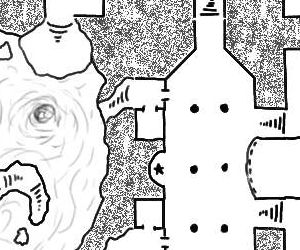
The Risus Monkey Mapper currently has 80 tiles (according to the site as I write this). The code for it is based on Dyson’s Random Morph Map, but the tile style is slightly different. The style is still sketch-like, but a little different from Dyson’s. I truly don’t have a preference between either style.
Although Dyson’s has more tiles and the variety seems greater than Hack/’s, the Risus Monkey’s Mapper seems to have even more variety for some reason. However, at this point we’re splitting hairs and I can’t give the two different grades.
Because it seems to be the same code as Dyson’s, it has the same drawbacks (as with Hack/’s). Saving the map can’t be done by clicking on the map, and it doesn’t try to key the rooms or describe them in any way. But as with Dyson’s, it does the grunt work of creating a random map well.
Scores: Customizability: I; Aesthetics: C; Variety: A-; Completeness: B+; Printing: B-; Text Descriptions: n/a
Adventure Generator! from Dizzy Dragon Games
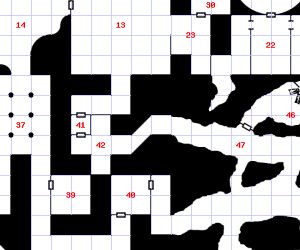
A new (I’m writing this in September 2010, but I saw it a month or two ago) and innovative random dungeon generator comes from Dizzy Dragon Games. It is innovative in how it combines the tile based generator concept while still being able to key the adventure areas. (As a programmer, I have an idea of it does this but I haven’t tried to look at the code behind it.)
Tile based generators typically have an issue with keying the rooms because each time the generator runs, a different set of tiles are produced so there is no easy way to assign rooms or parts of rooms numbers without:
- Reusing numbers or
- Deciding beforehand to key one tiles rooms 1-20, the next as 21-40, and so on. And in this case you completed map may have a set of tiles with numbers 21-40, 400-421, 160-180, 320-360, and so on.
But Adventure Generator! seems to predetermine where to place numbers and then places them as the tiles are determined which allows for one continuous numbering. Adventure Generator! also lets the user choose between several random dungeon stocking methods, dungeon dressing approaches and choose to either make a geomorphic dungeon or a 1e wilderness map. (Although the wilderness map is not currently stocked, described, etc.)
I like the style of the tiles and the variety, although maybe I like Hack/’s a touch better. Still, that’s nit-picking and a personal taste issue. Also one can’t click the map and save it, but as mentioned above that is a general limitation of tile based map generators.
The only negative that I can give it is that it really isn’t an “Adventure Generator” yet. Sure, it creates a dungeon, stocks it with monsters, traps, treasure and some flower text based on a few options but that isn’t really an adventure. What would be really cool would be if the generator spit out a bullet point plot and stocked the monsters, traps and treasure based on that plot.
But don’t take the criticism above as too negative. That’s really reaching for the stars, and I wouldn’t be surprised to see something like that added by an obviously talented creator if that person sees that direction as a good idea.
Scores: Customizability: B; Aesthetics: B-; Variety: A-; Completeness: B+; Printing: B-; Text Descriptions: B
Random Dungeon Generator from Inkwell Ideas
Full disclosure in case it isn’t obvious: This random generator is by me, the reviewer, so I won’t grade it but I’ll try to review it as fairly as I can. I reviewed most of the above random generators before starting my own.
The Inkwell Ideas tile-based random generator differs from the other tile-based generators in one way: the tiles join in multiple ways. For simplicity, most of the tile generators join tiles together by having one or two openings on each side of the tile. (But each generator only uses one join type, not both one opening and two openings.) These openings are typically used for corridors (whether they are finished dungeon corridors or narrow cave corridors) or sometimes as parts of rooms. But the Inkwell Ideas’ generator’s edges may each have two openings, two larger openings, one opening or none. And each tile may have any combination of these for its four edges.
This versatility does come at some cost: one must make sure that all combinations of tile edges have existing tiles. For example, when determining which tile to place, one must pick a tile that has the same number/size of openings on its top edge as the tile above it has on its bottom edge. The tile you are placing must have the same number/size of openings on its left edge as the tile to the left has on its right edge. And so on.
And by using the edge type as a marker for caverns, it is possible to group cave tiles together. (All caves tiles have two larger openings on at least one edge.)
The customizability is very limited because it it a tile-based generator and it does not currently do dungeon stocking/dressing. The only option at present allows you to approximately set the mix of finished dungeon tiles to cave tiles. Like the hack/ and Dizzy Dragon tile generators, saving is limited to taking a screenshot and using an outside image editing tool.
Scores: N/A.
Others
There are a few other random dungeon generators that don’t fit the focus of this article:
- How to Host a Dungeon: A pen and paper game that leads you through the construction of a dungeon over time. In the end you have a usable role-playing dungeon.
- Central Casting Dungeons: Another pen and paper system to create a dungeon. One review states that a large number of charts are used and the system suggests detailing each room on index cards.
- Age of Fable’s “Tunnels and Trolls” and “Labyrinth Lord Mutant Future” dungeon generators: Both of these generated very simplistic maps. They did include good additional text information, but the maps simply showed how the rooms were connected. The rooms were uniform in shape on the “map.”
- Also here at Inkwell Ideas is a random inn/tavern generator that does floorplans, menus, and a list of staff & patrons.
Summary
Unfortunately none of the random dungeon generators stands out in every way. Each category has a clear winner, but the winner of that category is average at best in some of the other categories.
Hopefully some of the people working on these generators will see what the others have done and improve their own such that one or more will score highly in each category.
Very useful review; I did not know about most of these.
How fun to see the beta I was working on showing up on this list. I had really hoped to get back to that project and finish things like the themes and the adventure seeds. Who knows maybe someday =)
I rather like random generators. Pity you can’t get the majority of them to work off-line. Sometimes I just don’t feel like being on the net (esp since I use dialup).
Frankly I would suggest (yes I know it is a roll your own) the Random Dungeon Generator straight out of AD&D 1st Edition DMG. Sure its retro and not an ounce of software in sight but the sooner we get someone to assemble an PC RDG from it, the sooner we will have something to compare it all against.
i’m the author of the demonweb RDG. thanks for all the reviews, it’s a good day when i learn about another generator.
the demonweb’s random dungeon is implemented as an HTML table, so printing well relies on having ‘print backgrounds’ set in the print preferences of your web browser. if this is set, then the printed page looks just like the dungeon on-screen. if not, then the solid cells are only slightly-filled-in by %% as you note.
time to break out GD and add an option to generate real images, i suppose. 🙂
cheers!
Specific OS requirements for each generator would be useful. I saw only one that specified “Windows only” or words to that effect, but nothing to suggest what other OSs will support the others.
The others are all web-based. No specific OS requirements. If you have a recent (or in most cases even an old) browser, you’re fine.
well, that was fun. the demonweb RDG now features an Output option. the default is still HTML (kinder to my poor server), but i’ve added the ability to generate the map as an image, in several different styles (standard, classic, parchment, and marble).
it might be fun to develop some styles to tie in to the dungeon motifs. suggestions are welcome, clearly.
the image is tied to a client-side imagemap, so hovering your cursor over rooms and doors should be useful, and clicking on a room should link to the full room description further down the page.
take that, other generators!
OMG a review of several different RDG online that I have been using in combination for years! I have been using Myth weavers (for the perfect map and base description and room layout). I make several word files of HUGE mythweaver room descriptions and save them for (copy/pasting) as I prefer a more pick and choose as opposed to a truly random dungeon. I found I also liked adding a general dungeon description from another site…then I work on setting a real map with it’s room descriptions…I found another site that has a really in depth trap listing….and start editing into my actual map/dungeon description/room description. Takes a long time but it is well worth the effort. I remember the days of the treasure creator you could buy…had it on the commadore 64. I have found only one thing missing so far for my perfection of the dungeon…a truly complete listing of creatures and their stats I could copy and paste into my room descriptions…and a real treasure generator based on treasure type. The only creature descriptions on myth weavers site is character based and many of the creatures are duplicated…almost all dungeons I’ve created had some form of dragon…even on level 1.
Thank you for taking the time to review those. It is always nice to be able to do more with less, and random dungeon generators fill that niche for you. But with so many different DM tastes, one man’s dungeon generator make work well for him, but not for someone else. Just showing us what is out there helps us find what is right for us. Kudos.
I am looking at some of these generators which seem really neat, but I want to use hex tiles for my combat system so more than four characters can surround/attack a single space. is this making sense? how come none of these have a hex option or am i missing it?
You don’t need hex tiles for more than 4 people to surround an enemy. Even with a simple grid you can have 8 people surround 1 person. As for a grid option, just quarter every second square and it will make a hex pattern for you. Although the pattern wont be to scale it can work for rough ideas.
These generators are intense. I remember how much work it took just to draw up something we liked before trying to fill it. You all are supreme in your skills. So…um… of course I have to ask for more. How about some stuff for out doors? What about if someone wants to go a distance before they get to the dungeons (or caves or what not)? Would overland be possible? Perhaps it can be more spread out so that one square equals 50 feet instead of 5 or 10. Having perhaps hills, dales, scrub land, deserts, shores of an ocean, or lake. I have Dundjinni and it is great for making maps but to have a generator that builds them (and perhaps even fills them) would be intense.
I have always thought it would be great to build my own world. The generators could help make that happen perhaps? Construct enough overland stuff, mountains, forests, deserts, ocean shores, lake shores, etc. and it could happen.
Gamers and GM’s have often just pushed the Overland travel out of the picture or they down play it to get the characters to the place they need them at (caves, dungeons, etc.). Unless of course they want to add something to the adventure. Like some scary forest. But for the most part, they seem to just say, OK, this happens and your here, in the dungeon. (kidnapped or what ever).
Now don’t be running off yet. I have more to request. What….of course I am going to ask for it all now. LOL.
Ok, I remember a module of something about Giants. They had a big keep and the characters had to go to it. So, what about something for generating keeps, castles, and perhaps even towns or villages? Again, the maps don’t have to be super detailed for every 5 feet, but something on line of the old stuff modules had. Also, (sure I am sill asking for more), what about buildings. Perhaps when they characters are in a town and they go into a building, the generator could ask for dimensions OR perhaps some kind of link where as, you click on a building and the generator knows the building size at least and you (the gm) fill in what it might be for (tavern, merchant, blacksmith, etc.). I am just thinking about the modules from the past and how it was great to have that visual available. Filling in the details might be a bit too much but getting the mapping is still VERY helpful.
So what do you think? Heck, perhaps you all might get together and put something together as a team. Think about that one. More over, set up a website where, if a person wants to sit there long enough, they can build it all with limited capacity or details or something AND if they want more, they can purchase the product.
Wasn’t there Cartographer or something like that out there. Well, perhaps your stuff could make that look bad. Or, perhaps Wizards of the Coast might be willing to work with you on it, or pay your team to build them one.
Oh-kay, I am done now. Yeah, it’s a lot I am asking for but hey, you have some great stuff here. So why not ask for more?
It looks like Skeleton Key Games put the smackdown on an unauthorized use of their tiles.
Thanks! I’ve removed the link and updated the review.
cool, more generators! you’ve a good start on yours, i’m going to have to go catch up on your development posts.
on a related note, the demonweb random dungeon generator has been moved onto my dedicated gaming site, donjon.bin.sh
i’ve made some more upgrades recently, most significantly an option for cavernous dungeon layouts.
which took more code than you might think. 🙂
These are all great, Your dungeons are truly unique, Inkwell. Drow, do you have any contact information, I have a couple suggestions for your Random Dungeon Generator (I cannot find an email on your website). They are not changes, just additional options or information for those with BattleMats and such. Thanks
an entry in the geomorphs lineage…
http://davesmapper.com/
Some of these don’t seem to be working anymore.
Some of these don’t seem to exist any more 🙂
However, there’s also dungeonstome (www.dungeonstome.com), which seems to be specific to D&D? At least it uses the random dungeon generation tables from the Dungeon Master’s Guide. Not many customisation options, but there’s no scope for customisation with the DMG system.